country
Mexico
From mariachi to corridos tumbados. A century of song
Listen through Mexico
5 defining tracks in the order they were released, from 1945 to 1990, each with a line on why it matters.
Preview: plays 5 of 16 tracks.
30-second previews, streamed from Apple.
Mexico's musical history runs through the cantina, the cinema, the dancehall, and the streaming chart. The bolero arrived from Cuba in the 1920s and Agustín Lara turned it into a national songbook. Pedro Infante, Jorge Negrete, and José Alfredo Jiménez built the canon of the ranchera during the golden age of Mexican cinema, and Lola Beltrán, Vicente Fernández, and Juan Gabriel carried it for decades. Carlos Santana exported Latin rock from a San Francisco stage; Caifanes, Café Tacvba, and Maldita Vecindad rebuilt rock en español from the inside; Luis Miguel and José José ruled the romantic ballad; norteño, cumbia, and banda built the everyday soundtrack. By the 2020s, Peso Pluma, Natanael Cano, and Junior H had reinvented the corrido for a global audience streaming from phones in every continent.
Frequently Asked Questions
What is the most iconic genre of Mexican music?+
Ranchera, performed with mariachi accompaniment, is Mexico's most iconic musical genre. Built around themes of love, heartbreak, and national pride, it was carried to its peak by Pedro Infante, Jorge Negrete, Lola Beltrán, and Vicente Fernández. UNESCO inscribed mariachi as Intangible Cultural Heritage of Humanity in 2011.
Who is Mexico's most famous musician?+
By global reach and historical importance, Pedro Infante and Vicente Fernández are the two most beloved Mexican singers of the 20th century. Among living and contemporary artists, Luis Miguel remains the most commercially successful Spanish-language male singer, and Peso Pluma became the country's biggest streaming export with his 2023 single Ella Baila Sola.
What is the difference between ranchera, norteño, and banda music?+
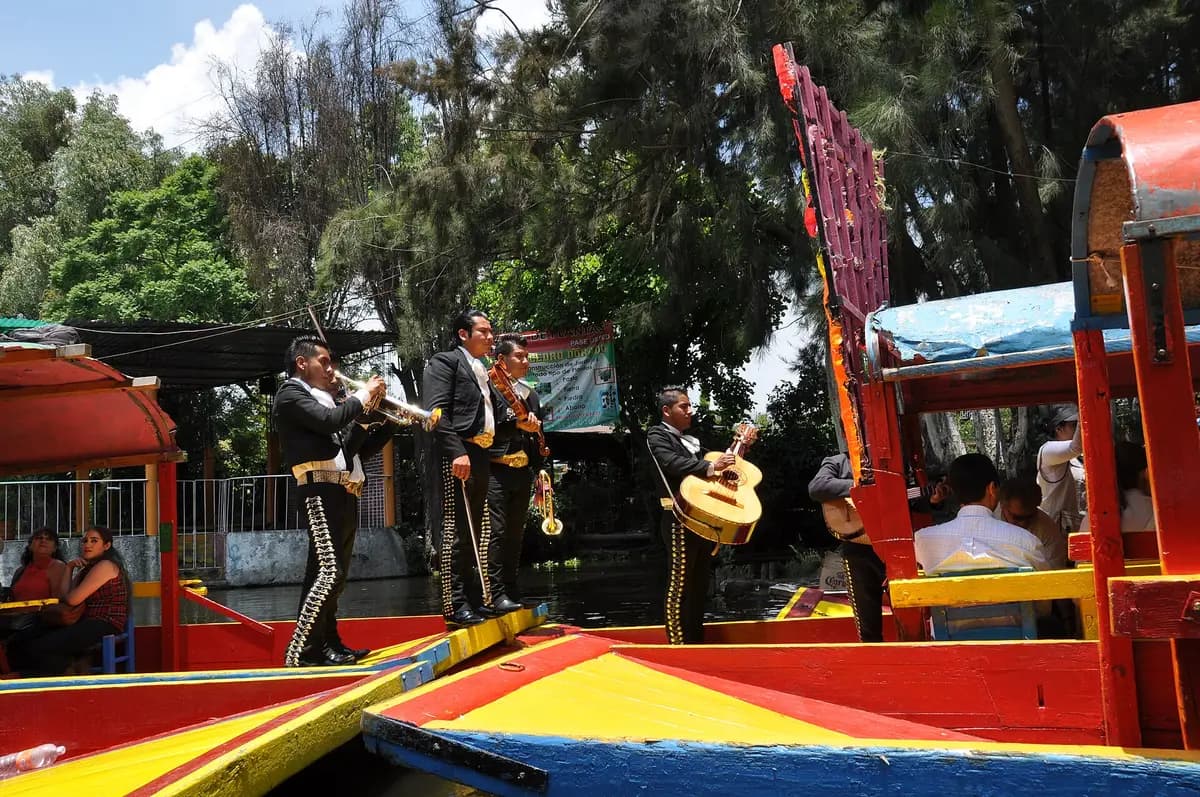
Ranchera is a song form, typically performed with mariachi ensemble (violins, trumpets, vihuela, guitarrón). Norteño comes from northern Mexico and the US border, built on accordion and bajo sexto and rooted in polka rhythms. Banda is a brass-and-percussion ensemble tradition from Sinaloa, with no string instruments and a heavier dance feel. All three carry the corrido narrative tradition.
What are corridos tumbados?+
Corridos tumbados are a 2020s reinvention of the corrido by Mexican and Mexican-American artists, fusing acoustic requinto with trap drums and hip-hop cadence. Natanael Cano coined the sound on his 2019 album Corridos Tumbados; Peso Pluma, Junior H, and Fuerza Regida built it into the fastest-growing Latin genre on streaming services.
Last reviewed: 2026-04
When was the golden age of Mexican music?+
The golden age of Mexican popular music runs from roughly 1936 through the late 1950s, overlapping with the golden age of Mexican cinema. Agustín Lara's bolero compositions, Pedro Infante and Jorge Negrete's ranchera films, and Lola Beltrán's early recordings defined the period. The era ended with Infante's death in a 1957 plane crash.
The Story Behind
The stories behind Mexico's defining songs
El Rey
Vicente Fernández
José Alfredo Jiménez never saw El Rey reach the top. He wrote and recorded the song in 1971, a portrait of a rough, hard-living man who insists that whatever his circumstances, he is still…
Read the storyAmor Eterno
Juan Gabriel
Juan Gabriel was on tour in Acapulco in 1974 when the news reached him that his mother had died. By his own account, that moment is the root of Amor Eterno, an elegy in which the loss, and…
Read the storyCucurrucucú Paloma
Lola Beltrán
Lola Beltrán got her start by refusing to stay behind a typewriter. She had moved from Sinaloa to Mexico City with her mother and found work as a secretary at the radio station XEW, where…
Read the storyOye Como Va
Santana
Before it was a rock anthem, Oye Como Va was a cha-cha-chá. Tito Puente wrote and recorded it with his orchestra in 1962 for Tico Records, with a repeating piano figure of block chords, a…
Read the storySources & References
- 1Mexican Music: Songs and Dances of Mexico — Vicente T. Mendoza, 1956Book
- 2The Mexican Corrido: A Feminist Analysis — María Herrera-Sobek, 1990Book
- 3Strange Sounds: Music, Technology and Culture — Timothy D. Taylor, 2001Book
- 4How Peso Pluma and corridos tumbados conquered the Latin charts — Suzy Exposito, 2023
- 5
- 6Mariachi, string music, song and trumpet (UNESCO ICH) — UNESCO Intangible Cultural Heritage, 2011
- 7Music of Mexico — Wikipedia contributors, 2026
Further Reading
About This Article
Our editorial team curates each location through a multi-phase process: landscape research, decade-by-decade era planning, a candidate pool drawn from canonical sources and contemporary streaming data, and a final hitlist verified for accuracy. Every YouTube video is checked against the source recording with yt-dlp and oembed, every internal link is HTTP-validated, and every claim is cross-referenced against at least two independent sources before publication.
timeline.music editorial, working with sources from the Universidad Nacional Autónoma de México, the Sistema Nacional de Fomento Musical, the Latin Grammy Recording Academy archive, UNESCO's Intangible Cultural Heritage records, and contemporary outlets including Billboard Latin, Rolling Stone en Español, and BBC Mundo.
▸Read the timeline as text
The sound of Mexico, decade by decade: 8 genres and 30 artists, from the 1920s to the 2020s.
- 1920s
- Bolero Mexicano with Agustín Lara.
- 1930s
- Bolero Mexicano with Agustín Lara; Ranchera with Jorge Negrete.
- 1940s
- Bolero Mexicano with Agustín Lara and Pedro Infante; Ranchera with Jorge Negrete, Pedro Infante and José Alfredo Jiménez; Banda with Banda El Recodo.
- 1950s
- Bolero Mexicano with Agustín Lara and Pedro Infante; Ranchera with Jorge Negrete, Pedro Infante, José Alfredo Jiménez and Lola Beltrán; Banda with Banda El Recodo.
- 1960s
- Bolero Mexicano with Agustín Lara and José José; Ranchera with José Alfredo Jiménez, Lola Beltrán and Chavela Vargas; Banda with Banda El Recodo; Rock en Español with Santana.
- 1970s
- Bolero Mexicano with José José; Ranchera with José Alfredo Jiménez, Lola Beltrán, Chavela Vargas and Vicente Fernández; Norteño with Los Tigres del Norte and Ramón Ayala; Banda with Banda El Recodo; Rock en Español with Santana; Pop Mexicano with José José.
- 1980s
- Bolero Mexicano with José José; Ranchera with Lola Beltrán, Vicente Fernández and Juan Gabriel; Norteño with Los Tigres del Norte, Chalino Sánchez and Ramón Ayala; Banda with Banda El Recodo; Rock en Español with Maldita Vecindad and Caifanes; Pop Mexicano with José José and Marco Antonio Solís.
- 1990s
- Bolero Mexicano with José José and Luis Miguel; Ranchera with Chavela Vargas, Vicente Fernández, Juan Gabriel and Alejandro Fernández; Norteño with Los Tigres del Norte, Chalino Sánchez and Ramón Ayala; Banda with Banda El Recodo; Cumbia Mexicana with Los Ángeles Azules; Rock en Español with Santana, Maldita Vecindad, Caifanes, Maná, Café Tacvba and Molotov; Pop Mexicano with José José, Marco Antonio Solís and Thalía.
- 2000s
- Bolero Mexicano with José José; Ranchera with Chavela Vargas, Vicente Fernández, Juan Gabriel and Alejandro Fernández; Norteño with Los Tigres del Norte and Ramón Ayala; Banda with Banda El Recodo and Banda MS; Cumbia Mexicana with Los Ángeles Azules; Rock en Español with Santana, Maldita Vecindad, Maná, Café Tacvba, Molotov and Julieta Venegas; Pop Mexicano with Marco Antonio Solís and Thalía.
- 2010s
- Ranchera with Vicente Fernández, Juan Gabriel and Alejandro Fernández; Norteño with Los Tigres del Norte; Banda with Banda El Recodo and Banda MS; Cumbia Mexicana with Los Ángeles Azules; Rock en Español with Santana, Maldita Vecindad, Caifanes, Maná, Café Tacvba, Molotov and Julieta Venegas; Pop Mexicano with Marco Antonio Solís and Thalía; Corridos Tumbados with Natanael Cano.
- 2020s
- Ranchera with Alejandro Fernández; Norteño with Los Tigres del Norte; Banda with Banda MS; Cumbia Mexicana with Los Ángeles Azules; Rock en Español with Santana, Maldita Vecindad, Café Tacvba, Molotov and Julieta Venegas; Pop Mexicano with Marco Antonio Solís and Thalía; Corridos Tumbados with Natanael Cano, Peso Pluma, Junior H and Neton Vega.
The Hitlist
The defining tracks from this region
Preview: 5 of 16 tracks
El Rey
Vicente FernándezVicente Fernández, Chente to his fans, sold more than 50 million records across five decades and was the last great voice of the traditional Mexican ranchera. He started as a busker in Guadalajara, broke through with El Rey and Volver, Volver in the 1970s, and spent the rest of his career filling stadiums in the charro suit and sombrero. He retired from touring in 2016 after a farewell concert in Mexico City's Estadio Azteca that lasted nearly four hours. His son Alejandro Fernández continued the family line; Vicente died in 2021 a national figure of mourning.