country
Slovenia
From Alpine polka to the Eurovision stage.
Listen through Slovenia
5 defining tracks in the order they were released, from 1955 to 1999, each with a line on why it matters.
Preview: plays 5 of 14 tracks.
30-second previews, streamed from Apple.
Two million people, eight musical decades. Slovenia built the Alpine polka template that travels under the name Oberkrain, ran one of socialist Europe's most fearless avant-garde scenes through Laibach and Borghesia, hosted the first Yugoslav punk band in Pankrti, and put a stadium rock canon on the map with Buldožer, Siddharta, and Joker Out. A small country with an outsized footprint, where every generation has its own way of singing in Slovene.
Frequently Asked Questions
What genres define Slovenian popular music?+
Five run through the country's musical history: narodno-zabavna (accordion-led Alpine folk-pop, exported internationally as the Oberkrain sound), Slovenian rock, Slovenian punk, an avant-garde and industrial scene tied to the Neue Slowenische Kunst collective, and a rich singer-songwriter (kantavtor) tradition. Together they trace eight decades, from Slavko Avsenik's 1955 polka "Na Golici" to Joker Out's 2023 Eurovision entry.
Who started the Oberkrain sound?+
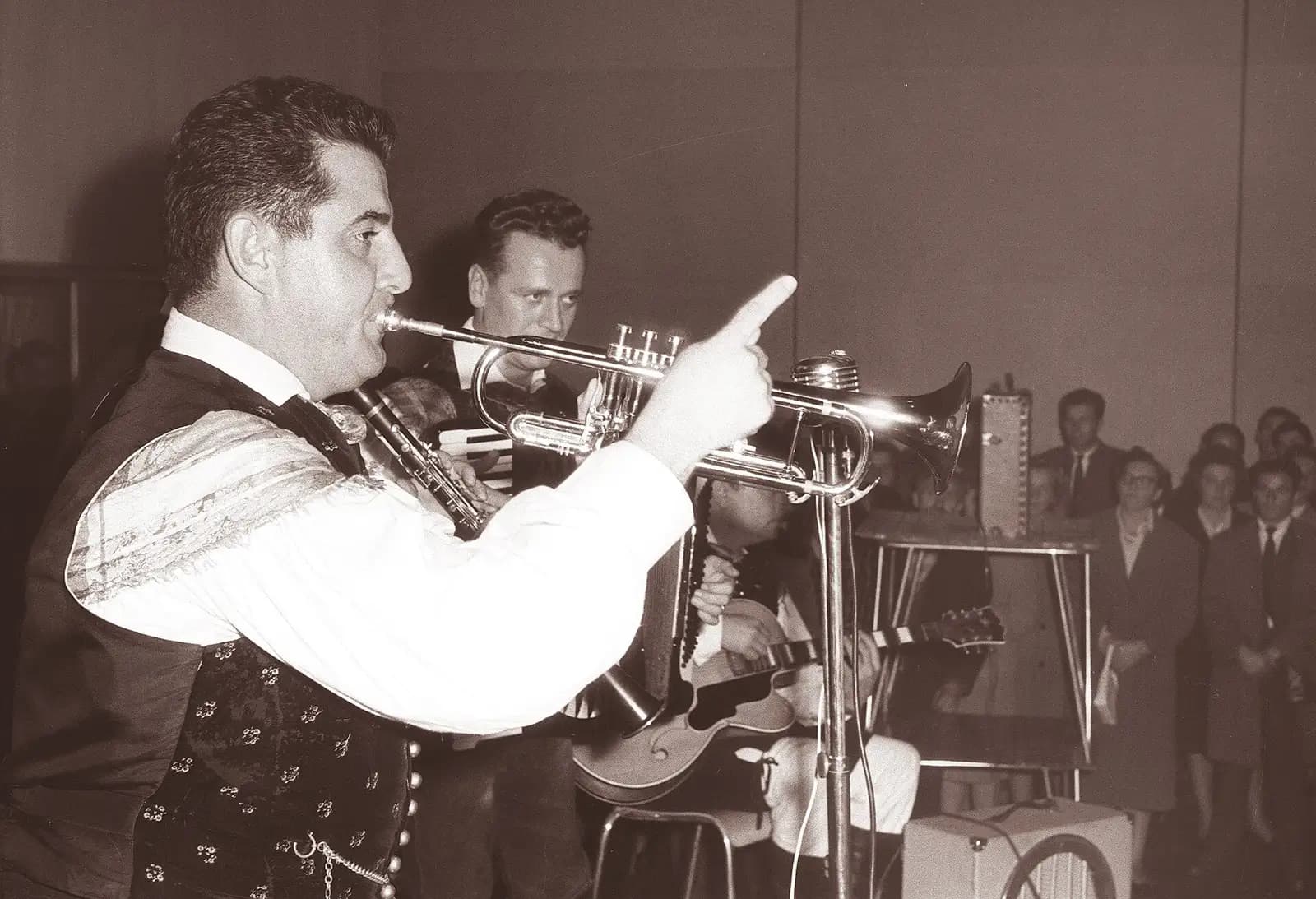
Slavko Avsenik and his brother Vilko founded Ansambel bratov Avsenik in 1953, and within a few years their accordion-and-clarinet polka template was the dominant face of Slovenian folk-pop and a huge export across Alpine Europe. "Na Golici," released in Germany as "Trompetenecho," became one of the most-played instrumentals in recorded history.
Why is Laibach so well known internationally?+
Laibach were founded in 1980 in the mining town of Trbovlje and built a global reputation by adopting and exposing the visual language of totalitarianism. As founding members of the Neue Slowenische Kunst collective, they straddle pop music, performance art, and political provocation. Among other firsts, they were the first Western band to play in North Korea, in 2015.
What did Joker Out's Eurovision year change?+
Joker Out's 2023 Eurovision entry "Carpe Diem" put a young Slovenian rock band on every European music platform at once. Unlike most post-Eurovision acts, they used the moment to tour Europe rather than chase a viral cycle, and their 2024 singles like "Bluza" landed on Spotify editorial playlists across the continent.
Last reviewed: 2026-06
What is the kantavtor tradition?+
Kantavtor is the Slovenian word for singer-songwriter. The tradition is usually dated to Tomaž Pengov's 1973 debut "Odpotovanja," widely considered the first proper Yugoslav singer-songwriter album: solo voice, acoustic guitar, literate Slovene lyrics that drew on medieval troubadour song as much as on Cohen or Dylan. Andrej Šifrer, Vlado Kreslin, and Iztok Mlakar carried the form forward into folk-rock, Prekmurje folk, and Mediterranean chanson.
The Story Behind
The stories behind Slovenia's defining songs
Na Golici
Ansambel bratov Avsenik
In 1954 Slavko Avsenik was working night shifts at the Tonosa factory in Ljubljana, knitting socks on a machine. While the machine ran on its own from foot to waist, he listened to its…
Read the storyLife Is Life
Laibach
Laibach formed in the mining town of Trbovlje on 1 June 1980 and chose a name designed to provoke: the German name for Ljubljana, used under Austrian rule and during the Nazi occupation.…
Read the storyLublana je Bulana
Pankrti
In 1977 two friends from the Ljubljana suburb of Kodeljevo, Gregor Tomc and Peter Lovšin, decided to start a band. They had been listening to British punk, Lovšin was already writing…
Read the storySources & References
- 1Music of Slovenia — Wikipedia contributors, 2025
- 2Laibach: Slovenia's industrial agitators on Brexit, Trump and 40 years of provocation — Alexis Petridis, 2020
- 3Joker Out: The Slovenian band rewriting the post-Eurovision playbook — BBC Music, 2024
- 4Slavko Avsenik, Slovenian musician who created the Oberkrain sound, dies aged 86 — The Telegraph obituaries, 2015
- 5Neue Slowenische Kunst — Alexei Monroe, 2005Book
Further Reading
About This Article
This page is based on documented music history, artist biographies, chart data, award records, and cross-referenced sources from music journalism and academic research.
Curated by the timeline.music editorial team.
▸Read the timeline as text
The sound of Slovenia, decade by decade: 5 genres and 18 artists, from the 1950s to the 2020s.
- 1950s
- Narodno-zabavna with Ansambel bratov Avsenik.
- 1960s
- Narodno-zabavna with Ansambel bratov Avsenik.
- 1970s
- Narodno-zabavna with Ansambel bratov Avsenik; Slovenian Rock with Buldožer and Lačni Franz; Slovenian Punk with Pankrti and Pero Lovšin; Slovenian Singer-Songwriter with Tomaž Pengov and Andrej Šifrer.
- 1980s
- Narodno-zabavna with Ansambel bratov Avsenik; Slovenian Rock with Buldožer and Lačni Franz; Slovenian Punk with Pankrti, Niet and Pero Lovšin; Slovenian Avant-Garde with Laibach and Borghesia; Slovenian Singer-Songwriter with Tomaž Pengov, Andrej Šifrer and Vlado Kreslin.
- 1990s
- Narodno-zabavna with Ansambel bratov Avsenik; Slovenian Rock with Buldožer, Lačni Franz, Siddharta, Mi2 and Big Foot Mama; Slovenian Punk with Niet and Pero Lovšin; Slovenian Avant-Garde with Laibach, Borghesia and Magnifico; Slovenian Singer-Songwriter with Tomaž Pengov, Andrej Šifrer, Vlado Kreslin and Iztok Mlakar.
- 2000s
- Narodno-zabavna with Modrijani; Slovenian Rock with Siddharta, Mi2 and Big Foot Mama; Slovenian Punk with Niet and Pero Lovšin; Slovenian Avant-Garde with Laibach and Magnifico; Slovenian Singer-Songwriter with Tomaž Pengov, Andrej Šifrer, Vlado Kreslin and Iztok Mlakar.
- 2010s
- Narodno-zabavna with Modrijani; Slovenian Rock with Siddharta, Mi2, Big Foot Mama and Joker Out; Slovenian Punk with Niet and Pero Lovšin; Slovenian Avant-Garde with Laibach, Borghesia and Magnifico; Slovenian Singer-Songwriter with Tomaž Pengov, Andrej Šifrer, Vlado Kreslin and Iztok Mlakar.
- 2020s
- Narodno-zabavna with Modrijani; Slovenian Rock with Mi2, Big Foot Mama and Joker Out; Slovenian Punk with Pero Lovšin; Slovenian Avant-Garde with Laibach, Borghesia and Magnifico; Slovenian Singer-Songwriter with Andrej Šifrer, Vlado Kreslin and Iztok Mlakar.
The Hitlist
The defining tracks from this region
Preview: 5 of 14 tracks
Na Golici
Ansambel bratov AvsenikThe Slovenian ensemble founded by accordionist Slavko Avsenik and his brother Vilko in 1953 that defined a whole genre: narodno-zabavna or Oberkrain style folk-pop, an accordion-led, three-or-five-piece sound that fused Alpine waltzes, polkas, and Slovenian folk into something millions could hum. Their instrumental polka "Na Golici" (also released as "Trompetenecho") became one of the most-played instrumentals in recorded history. For seven decades, Avsenik's sound has been Slovenia's musical postcard, copied across the Alps and exported as the global template for Alpine folk-pop.